Providing Quick Links to News Stories of Local Interest. Feel FREE to come back and leave comments on any story. Yes, even anonymously.... No Subscription Fees--No Registration!!! Enjoy!!! http://HermannMoNews.blogspot.com/
HERMANN MISSOURI OKTOBERFEST 2010
HERMANN MISSOURI OKTOBERFEST 2010 - CLICK ON PHOTO FOR THIS YEARS SCHEDULE OF EVENTS
The 190-foot-tall whirling aerial swing in the Wunderland Kalkar amusement park, near the German-Dutch border, claims an unusual distinction: It’s the only ride in the world constructed in a decommissioned nuclear cooling tower. In 1995, Dutch developer Hennie van der Most bought the defunct nuclear power plant from the German government. The site was supposed to house an SNR 300 fast breeder reactor, built from 1972 to 1985, but it never became fully operational.
_________________________________________________________________________
By Nick Stattpopsci.com
October 5, 2011
__________________________________________________________________________
After the sale, van der Most converted the plant site into a theme park and recreation center. Wunderland Kalkar sees an average of 600,000 visitors a year and boasts more than 40 attractions, including rock-climbing on the outer walls of the cooling tower.
___________________________________________ _____________________________________ . . Donate To Keep This Site Alive
______________________________________________________ ___________________________ . .
VIDEO: MISSOURI THE BEAUTIFUL Take a patriotic tour of the Show Me State's natural wonders . . ========================================================== .
Jefferson, St. Louis counties report first cases of West Nile virus this year
September 8, 2011 www.stltoday.com
__________________________________________________________________________
A 49-year-old Jefferson County man developed a severe case of West Nile virus, county health officials said Thursday. State health records show the man was hospitalized, but his current condition is unknown. Also Thursday, St. Louis County health officials said a Wellston boy was briefly hospitalized after being infected by the virus. The boy, 12, had a fever for three or four days with nausea and vomiting. His was the first case reported in St. Louis County this year. In 2010, the county reported one case of West Nile virus. A 48-year-old St. Louis city woman who became infected in August was the first case reported in the state this year. There have been five West Nile virus cases in Illinois this year. The virus, which is transmitted by mosquitoes, can cause flu-like symptoms. Most people who catch the virus do not develop any symptoms, although in very rare cases it can be fatal. The St. Louis County health department says the mosquito season won't be over for several weeks and reminds people to get rid of standing water outside and wear repellents.
___________________________________________ _____________________________________ . . Donate To Keep This Site Alive
______________________________________________________ ___________________________ . .
VIDEO: MISSOURI THE BEAUTIFUL Take a patriotic tour of the Show Me State's natural wonders . . ==========================================================
It's not just the threat of another recession that tells us we're destroying ourselves. We express it in every alien movie ever made.
Save the Earth. Save the Earth. A question that, increasingly, offers the question: "Why?"
Still we, cranially deficient as we are, prefer to muse about "when?" and "how?" Well, the earthy Guardian points me to a new NASA report, written by scientists at NASA and Penn State.
The report suggests that is just remotely, theoretically possible that the green, blue and orange beings out there might notice that we're sending out a lot more greenhouse gases.
In noticing these noxious emissions, the aliens might consider that our puny planet offers more of a threat than they had previously imagined. This, the report goes on to wonder, might signal to those up there that we are a rapidly expanding entity, one that needs to be nipped before it buds any further.
In order to make their point, the aliens might swoop down upon us and crush our little bodies like those of so many useless eyebrowed ants. (I paraphrase.)
The NASA report, philosophically titled "Would contact with extraterrestrials benefit or harm humanity? A scenario analysis", offers many pie in the sky (or face) possibilities.
It offers three basic categories of scenario: beneficial, neutral, or totally bloody scary. (Again, I paraphrase but only very slightly.)
In essence, aliens might turn out to be highly cool dudes who only want to learn how to play croquet, make baked Alaska, and teach us how to zap political or social opponents with just a laser emerging from a fingernail.
The second possibility is that they could find us to be a nuisance, a feeling that we might reciprocate. The report posits that they might be merely creepy like those prawns in "District 9." They might also be more bureaucratic than the DMV, which would drive us to paroxysms of frustration.
Or they just might want to bake Alaska and eat us for the crunchy texture of our ears. This might happen because aliens are mean-spirited or merely because they're slightly clumsy.
We have, it's true, already been warned by Stephen Hawking that aliens might truly hate our guts, leading them to eat our guts. But this report tries to concoct many and varied storylines of our future relationship with other beings.
You might be among those who, on reading this report, decide that its conclusion is: well, anything could happen. However, the scientists reportedly went through this exercise so that we might consider how we're living now and any changes we might choose to make in anticipation of one of their scenarios.
Some might imagine that thinking too far into the future is beyond the scope of a world that is dominated by entities that only care about the results achieved every three months.
Donate To Keep This Site Alive
______________________________________________________ ___________________________ . .
VIDEO: MISSOURI THE BEAUTIFUL Take a patriotic tour of the Show Me State's natural wonders . . _____________________________________________________________________________
August 2, 2011
___________________________________________________________________________
NACOGDOCHES (CBSDFW.COM) - The drought currently impacting much of the state is helping in the recovery of debris from the 2003 space shuttle Columbia disaster.
Low lake levels have led to the emergence of what looks like a tank, about four foot in diameter, from the doomed shuttle.
Columbia came apart during re-entry over East Texas on February 1, 2003, killing all seven astronauts on board. The debris field spread from the eastern part of North Texas to a large area around Nacogdoches.
The tank was discovered in a part of Lake Nacogdoches which is normally 18 feet under water. The drought has drained that part of the lake and the object is now exposed.
Nacogdoches police have sent photos to NASA to see if the debris is indeed part of Columbia. Police are warning that if the object is part of the shuttle, it’s government property and anyone tampering with it would be subject to prosecution.
___________________________________________ _____________________________________ . . Donate To Keep This Site Alive
______________________________________________________ ___________________________ . .
VIDEO: MISSOURI THE BEAUTIFUL Take a patriotic tour of the Show Me State's natural wonders . . _____________________________________________________________________________
This undated photo provided by Luis Chiappe shows the Berlin specimen of Archaeopteryx lithographica, housed at Berlin's Museum für Naturkunde. The Berlin specimen of Archaeopteryx lithographica, widely considered the earliest known bird, is getting a rude present on the 150th birthday of its discovery: A new analysis says Archaeopteryx isn’t a bird at all. (AP Photo/Luis Chiappe)
_________________________________________________________________________
Famed fossil isn't a bird after all, analysis says
By MALCOLM RITTER AP Science Writer
July 27, 2011
___________________________________________________________________________
NEW YORK (AP) -- One of the world's most famous fossil creatures, widely considered the earliest known bird, is getting a rude present on the 150th birthday of its discovery: A new analysis suggests it isn't a bird at all.
Chinese scientists are proposing a change to the evolutionary family tree that boots Archaeopteryx off the "bird" branch and onto a closely related branch of birdlike dinosaurs.
Archaeopteryx (ahr-kee-AHP'-teh-rihx) was a crow-sized creature that lived about 150 million years ago. It had wings and feathers, but also quite un-birdlike traits like teeth and a bony tail. Discovered in 1861 in Germany, two years after Charles Darwin published "On the Origin of Species," it quickly became an icon for evolution and has remained popular since.
The Chinese scientists acknowledge they have only weak evidence to support their proposal, which hinges on including a newly recognized dinosaur.
Other experts say the change could easily be reversed by further discoveries. And while it might shake scientific understanding within the bird lineage, they said, it doesn't make much difference for some other evolutionary questions.
Archaeopteryx dwells in a section of the family tree that's been reshuffled repeatedly over the past 15 or 20 years and still remains murky. It contains the small, two-legged dinosaurs that took the first steps toward flight. Fossil discoveries have blurred the distinction between dinosaurlike birds and birdlike dinosaurs, with traits such as feathers and wishbones no longer seen as reliable guides.
"Birds have been so embedded within this group of small dinosaurs ... it's very difficult to tell who is who," said Lawrence Witmer of Ohio University, who studies early bird evolution but didn't participate in the new study.
The proposed reclassification of Archaeopteryx wouldn't change the idea that birds arose from this part of the tree, he said, but it could make scientists reevaluate what they think about evolution within the bird lineage itself.
"Much of what we've known about the early evolution of birds has in a sense been filtered through Archaeopteryx," Witmer said. "Archaeopteryx has been the touchstone... (Now) the centerpiece for many of those hypotheses may or may not be part of that lineage."
The new analysis is presented in Thursday's issue of the journal Nature by Xing Xu of the Chinese Academy of Sciences in Beijing, and colleagues. They compared 384 specific anatomical traits of 89 species to figure out how the animals were related. The result was a tree that grouped Archaeopteryx with deinonychosaurs, two-legged meat-eaters that are evolutionary cousins to birds.
But that result appeared only when the analysis included a previously unknown dinosaur that's similar to Archaeopteryx, which the researchers dubbed Xiaotingia zhengi. It was about the size of a chicken when it lived some 160 million years ago in the Liaoning province of China, home to many feathered dinosaurs and early birds.
Julia Clarke of the University of Texas at Austin, who did not participate in the study, said the reclassification appeared to be justified by the current data. But she emphasized the study dealt with a poorly understood section of the evolutionary tree, and that more fossil discoveries could very well shift Archaeopteryx back to the "bird" branch.
Anyway, moving it "a couple of branches" isn't a huge change, and whether it's considered a bird or not is mostly a semantic issue that doesn't greatly affect larger questions about the origin of flight, she said.
Luis Chiappe, an expert in early bird evolution at the Natural History Museum of Los Angeles County who wasn't part of the new study, said he doesn't think the evidence is very solid.
"I feel this needs to be reassessed by other people, and I'm sure it will be," he said.
___________________________________________ _____________________________________ . . Donate To Keep This Site Alive
______________________________________________________ ___________________________ . .
VIDEO: MISSOURI THE BEAUTIFUL Take a patriotic tour of the Show Me State's natural wonders . . _____________________________________________________________________________
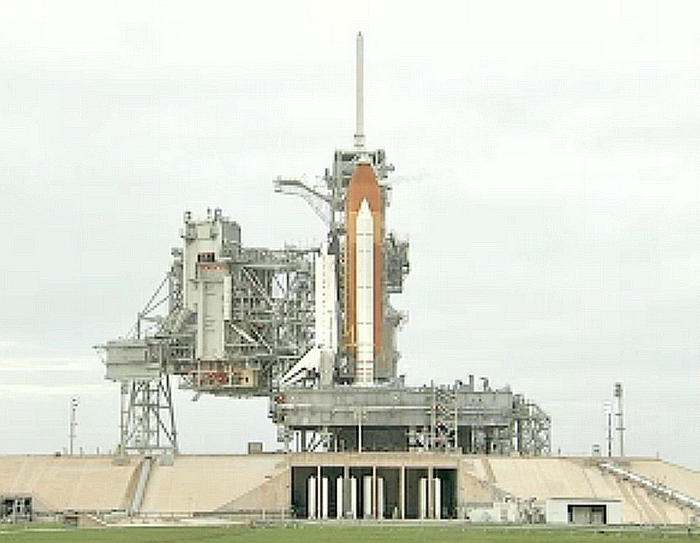
CAPE CANAVERAL, Fla. (AP) -- Atlantis and four astronauts rocketed into orbit Friday on NASA's last space shuttle voyage, dodging bad weather and delighting hundreds of thousands of spectators on hand to witness the end of an era.
It will be at least three years - possibly five or more - before astronauts launch again from U.S. soil, and so this final journey of the shuttle era packed in crowds and roused emotions on a scale not seen since the Apollo moon shots.
After days of gloomy forecasts full of rain and heavy cloud cover, the spaceship lifted off at 11:29 a.m. - just 2 1/2 minutes late - thundering away on the 135th shuttle mission 30 years and three months after the very first flight. The four experienced space fliers rode Atlantis from the same pad used more than a generation ago by the Apollo astronauts.
The shuttle was visible for 42 seconds before disappearing into the clouds.
NASA waived its own weather rules to allow the liftoff to go forward. In the end, though, the countdown was delayed not by the weather but by the need to verify that the launch pad support equipment was retracted all the way.
The crew will deliver a year's worth of critical supplies to the International Space Station and return with as much trash as possible. Atlantis is scheduled to come home on June 20 after 12 days in orbit.
Before taking flight, Commander Christopher Ferguson saluted all those who contributed over the years to the shuttle program.
"The shuttle is always going to be a reflection of what a great nation can do when it dares to be bold and commits to follow through," he said. "We're not ending the journey today ... we're completing a chapter of a journey that will never end."
It wasn't clear until the final moments of the countdown that the launch would come off. That was fitting in a way, since Florida's famously stormy weather delayed numerous shuttle missions almost from the start of the program and was a major reason spaceflight never became routine, as NASA had hoped for.
Hundreds of thousands of spectators jammed Cape Canaveral and surrounding towns for the emotional farewell. Kennedy Space Center itself was packed with shuttle workers, astronauts and 45,000 invited guests, the maximum allowed.
NASA's original shuttle pilot, Robert Crippen, now 73, was among the VIPs. He flew Columbia, along with Apollo 16 moonwalker John Young, on the inaugural test flight in 1981.
Other notables on the guest list: a dozen members of Congress, Cabinet members, the chairman of the Joint Chiefs of Staff, four Kennedy family members, Jimmy Buffett, Gloria Estefan and two former NASA chiefs.
The space shuttle was conceived even as the moon landings were under way, deemed essential for building a permanent space station. NASA brashly promised 50 flights a year - in other words, routine trips into space - and affordable service.
But the program suffered two tragic accidents that killed 14 astronauts and destroyed two shuttles, Challenger in 1986 and Columbia in 2003. NASA never managed more than nine flights in a single year. And the total tab was $196 billion, or $1.45 billion a flight.
Yet there have been some indisputable payoffs: The International Space Station would not exist if it were not for the shuttles, and the Hubble Space Telescope, thanks to repeated tuneups by astronauts, would be a blurry eye in the sky instead of the world's finest cosmic photographer.
The station is essentially completed, and thus the shuttle's original purpose accomplished. NASA says it is sacrificing the shuttles because there is not enough money to keep the expensive fleet going if the space agency is to aim for asteroids and Mars.
Thousands of shuttle workers will be laid off within days of Atlantis' return, on top of the thousands who already have lost their jobs. And the three remaining shuttles will become museum pieces.
This day of reckoning has been coming since 2004, a year after the Columbia tragedy, when President George W. Bush announced the retirement of the shuttle and put NASA on a course back to the moon. President Barack Obama canceled the back-to-the-moon program in favor of trips to an asteroid and Mars.
But NASA has yet to work out the details of how it intends to get there, and has not even settled on a spacecraft design.
The space shuttle demonstrates America's leadership in space, and "for us to abandon that in favor of nothing is a mistake of strategic proportions," lamented former NASA Administrator Michael Griffin, who led the agency from 2005 to 2008.
After Atlantis' lights-out, 33rd flight, private rocket companies will take over the job of hauling supplies and astronauts to the space station. The first supply run is targeted for later this year, while the first trip with astronauts is projected to be years away.
Until those flights are up and running, American astronauts will be hitching rides to and from the space station via Russian Soyuz capsules, at more than $50 million per trip.
Russia will supply the rescue vessels for Ferguson and his crew if Atlantis ends up severely damaged in flight. But the Russian spaceships can carry only three people, including two crew members, and any rescue would require a series of back-and-forth trips. That is why only four astronauts are flying Atlantis, the smallest crew in decades.
That reliance on Russia - with no other backup - has many space veterans worried. A contingent of old-time flight directors and astronauts, Crippen included, is seeking a last-ditch reprieve for the space shuttle, at least until something is ready to take its place.
Crippen acknowledged it is futile at this point.
"I'm afraid that ship has sailed," he said on the eve of the launch. But noting the improvements that had been made in the shuttles over the past three decades, he said: "Those vehicles, in my opinion, could fly for another 30 years and could be flown safely."
This last journey by Atlantis may be stretched to 13 days if enough power can be conserved. Weather permitting, Atlantis will return to Kennedy, where it will be put on public display. Discovery and Endeavour already are retired and being prepped for museums across the country.
Donate To Keep This Site Alive
______________________________________________________ ___________________________ . .
VIDEO: MISSOURI THE BEAUTIFUL Take a patriotic tour of the Show Me State's natural wonders . . _____________________________________________________________________________
IT looks like any other city skyline with skyscrapers, a few mountains and trees - except it isn't real.
The giant mirage appeared across the skyline near in East China earlier this month after heavy rainfall and humid conditions along the Xin’an River.
As mist settled over the river at dusk, tall buildings appeared to rise from nowhere, leading residents in nearby Huanshan City to speculate that the vision may be a "vortex" to a lost civilisation. Scroll down to see amazing footage of the ghost city
"It's really amazing, it looks like a scene in a movie, in a fairlyland," one resident told UK news channel ITN.
The mysterious city had vanished just as quickly as it had come.
Scientists have quashed the vortex theory and, as per usual, have a simple explanation for the incredible sight.
They believe it may have been a mirage, caused when moisture in the air becomes warmer than the temperature of the water below.
When rays of sunlight cross from the colder air into the warmer air they are refracted or bent – creating a reflection in the air that looks similar to a reflection in water.
It's a common sight for many travellers on Australian roads. But we Australians tend to see puddles of water that disappear when you get close, not entire cities floating on rivers.
Donate To Keep This Site Alive
______________________________________________________ ___________________________ . .
VIDEO: MISSOURI THE BEAUTIFUL Take a patriotic tour of the Show Me State's natural wonders . . _____________________________________________________________________________
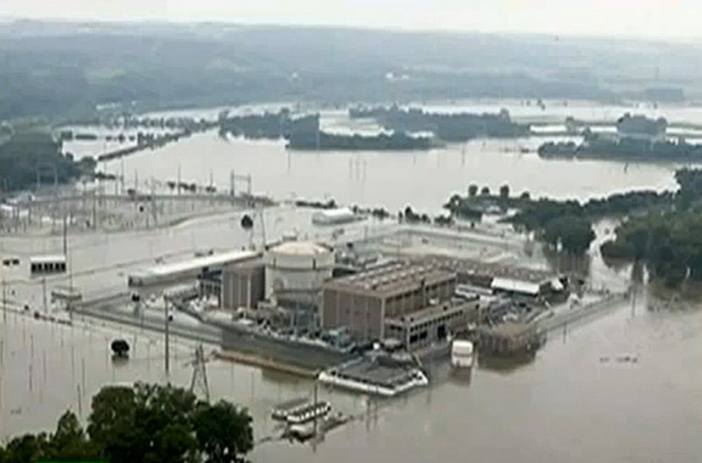
After the Fukushima nuclear catastrophe in Japan - a lot of people wondered out loud just what the hell the Japanese were doing building nuclear power plants along the coast of an area prone to earthquakes and tsunamis. It's as though they were just asking for this to happen - who could have been so stupid?? Surely - here in the United States we're a lot more careful with where we build OUR nuclear plants right?? Well...no. The Fort Calhoun Nuclear Plant just outside Omaha, Nebraska is completely surrounded by water. But I suppose that's what happens when you build a nuclear plant right in the middle of the flood plain of the Missouri River. Flood waters from the rising Missouri River have settled at a foot and a half ABOVE where the plant sits - and the only thing stopping Fort Calhoun from flooding just like Fukushima flooded is a six-foot high rubber wall surrounding the plant. But that's not the only nuclear power plant in danger. Just down the river in southeast Nebraska - the Cooper Nuclear Plant - is also on the verge of flooding out
Jun 22, 2011
.
Donate To Keep This Site Alive
______________________________________________________ ___________________________ . .
VIDEO: MISSOURI THE BEAUTIFUL Take a patriotic tour of the Show Me State's natural wonders . . _____________________________________________________________________________
Battered Asteroid a Survivor From Solar System's BirthCredit: ESA Full StoryThe asteroid Lutetia at closest approach as seen by Europe's Rosetta spacecraft in July 2010.
Asteroid to Pass Extremely Close By Earth On Monday
by Joe Rao, SPACE.com Skywatching Columnist
June 25, 2011
___________________________________________________________________________
Trajectory of asteroid 2011 MD during its June 27, 2011 flyby from the general direction of the sun. CREDIT: NASA
Here's something to dwell on as you head to work next week: A small asteroid the size of a tour bus will make an extremely close pass by the Earth on Monday, but it poses no threat to the planet The asteroid will make its closest approach at 1:14 p.m. EDT (1714 GMT) on June 27 and will pass just over 7,500 miles (12,000 kilometers) above the Earth's surface, NASA officials say. At that particular moment, the asteroid — which scientists have named 2011 MD — will be sailing high off the coast of Antarctica, almost 2,000 miles (3,218 km) south-southwest of South Africa.
___________________________________________ _____________________________________ . .
Donate To Keep This Site Alive
______________________________________________________ ___________________________ . .
VIDEO: MISSOURI THE BEAUTIFUL Take a patriotic tour of the Show Me State's natural wonders . . _____________________________________________________________________________
Prestigious doctor: US nuclear ’Baby valley of death,’ Millions to die
June 25, 2011
Deborah Dupre The Examiner
___________________________________________________________________________
Dr. Mark Sircus bearer of tragic radiation news
Sunday, the prestigious Doctor Mark Sircus released a new report concurring with a host of scientists and other doctors giving evidence that people of Japan and United States have been subjected to dangerous levels of radiation since Fukushima nuclear plant meltdowns, and also subjected to a tight cover-up by authorities and media, the result of which will be millions of baby deaths and new cancer victims. Japanese and American children are already suffering with symptoms that appear to be the first signs of Radiation Sickness.
"Finally, three months later, we are getting some numbers on what the real dangers are. And finally we can begin to understand the enormous cover-up of the nuclear doom that is reaching lungs all over the west coast of America, Canada, Alaska, Hawaii and at least half of Japan!" stated Dr. Mark Sircus.
Dr. Sircus Ac., OMD, is director of International Medical Veritas Association (IMVA) http://www.imva.info/. He was trained in acupuncture and oriental medicine at Institute of Traditional Medicine in Sante Fe, N.M., and at the School of Traditional Medicine of New England in Boston. He served at the Central Public Hospital of Pochutla in Mexico, and was awarded the title of doctor of oriental medicine for his work including one of the first nationally certified acupuncturists in the U.S. Dr. Sircus's IMVA is dedicated to unifying various disciplines in medicine with the goal of creating a new dawn in healthcare.
"For infants, it’s a terrible valley of death we have created for them." says Dr. Sircus. "As we shall see for years, all of them have been born with already polluted bloodstreams and now, the very young ones are dying in greater numbers on the west coast of the United States since Fukushima blew up."
No way to avoid tiny hot particles
"After the first week, officials had enough information to call for evacuation of a wide area in Japan and also Hawaii, Alaska and the entire west coast of North America," said Dr. Sircus.
All of northern Japan and the U.S. west coast should have been evacuated according to Dr. Sircus, admittedly "as impossible as evacuating the entire planet or the entire northern hemisphere."
"Avoiding exposure is always the best plan but there is no way to avoid breathing in air contaminated with tiny hot particles. Inhalation issues are much more frightening than ingestion issues because you can pick and choose what you eat and drink but you can't buy bottled air."
"Nuclear Toxicity Syndrome," one of the books authored by Dr. Sircus, is about "how to survive in nuclear and chemical hell," he says. Dr. Sircus, a founding guide of Gulf Coast Barefoot Doctors, deliverers of Detox Survival Kits to hundreds of Gulf Of Mexico BP oil and Corexit poisoned survivors.
Echoing the frustration of many Gulf of Mexico "barefoot doctors" and other volunteers since the BP oil catastrophe there over a year ago, Dr. Sircus states that "one cannot do what is necessary to survive hell if a person doesn’t know they are living in one." The problem is that, due to the media blackout on environmental hazards associated with non-renewable energy big business, relatively few people know the hell Gulf Coast people are enduring. Many Gulf Coast residents continue to attribute ongoing illness to a persistent "flu." Just as more people are doing today in relation to Fukushima radiation, many Gulf Coast residents remain in denial that Gulf of Mexico radiation from seeping oil and antibiotic resistant bacteria from the dispersant Corexit are lethal and government has not helped them. This is why Dr. Sircus and many health professionals contributed to the work of Mr. Jeff Rense for his book, "Coming Clean: From Denial to Detox" that he freely offers to save lives.
Despite mixed reports from officials and media about the vulnerability of United States nuclear plants threatened by flooding, Dr. Sircus highlights, "It just keeps getting worse by the day, and now we have Fort Calhoun nuclear plant outside Omaha, Nebraska on emergency alert as first fire and now flooding threatens to overwhelm yet another nuclear facility."
Advertisement
"We knew nuke power plants were bad news, but who would think they would build them on fault lines or in flood zones?" he asks.
Should US West Coast residents be worried?
While people like Arnie Gundersen have tiptoed the answer to whether west coasters should be worried about Fukushima fallout, Dr. Sircus answered more bluntly:
"I am afraid I will have to be brutally honest and be the bearer of really terrible news. The information coming out about hot particle concentrations near Fukushima, Tokyo, and now Seattle tell us that not only should all those populations be worrying but their governments should have been issuing evacuation orders months ago."
"Because of the jet stream in April, after the large explosions that destroyed three reactor buildings, it was as dangerous in Seattle and much of the west coast of North America as in Tokyo." (Emphasis added)
According to Dr. Sircus, the average Tokyo resident is thought to have inhaled 10 “hot particles” per day throughout April 2011. Inhabitants of Fukushima were estimated to have inhaled 30-40 times more than that—up to 400 hot particles per day every day that month.
In Seattle, WA, it is estimated that the average person absorbed five “hot particles” per day during April 2011, or 10 “hot particles” per day if athletes working out.
"These invisible atomic particles become lodged in your lungs, intestines, bone or muscle."
Being very conservative and saying this has dropped to even one a day "would still be 30 of these death particles a month, approximately 200 radioactive particles into their lungs and other tissues by now.
"When you think that if even one of these 200 is plutonium," states Dr. Sircus, "we have to think in terms of millions of eventual cancer deaths."
Dr. Mark Sircus recently released e-books including: Winning the War Against Cancer, Survival Medicine for the 21st Century, Sodium Bicarbonate, Rich Man’s Poor Man’s Cancer Treatment, New Paradigms in Diabetic Care and Bringing Back the Universal Medicine: IODINE.
He is a pioneer in natural detoxification and chelation of toxic chemicals and heavy metals and a champion of the medicinal value of minerals and seawater. Transdermal Magnesium Therapy, his first published work, offers a stunning breakthrough in medicine, an entirely new way to supplement magnesium that naturally increases DHEA levels, brings cellular magnesium levels up quickly, relieves pain, brings down blood pressure and pushes cell physiology in a positive direction. Magnesium chloride delivered transdermally brings a quick release from a broad range of conditions.
. VIDEO: Nuclear Hell On Earth: Night film video evidence of Fukushima plant radiation in air
Night filmed radioactive steam from Fukushima 24 hours/day. Arnie Gundersen, former nuclear power industry executive is among many experts saying from day one: Japanese nuclear crisis is much worse than they were telling us. Credit: MrSmotegi/Youtube/Dr. Mark Sircus
.
Donate To Keep This Site Alive
______________________________________________________ ___________________________ . .
VIDEO: MISSOURI THE BEAUTIFUL Take a patriotic tour of the Show Me State's natural wonders . . _____________________________________________________________________________
By Anne Landman
June 24, 2011www.indypendent.org
___________________________________________________________________________
While the U.S. media has been occupied with Anthony Weiner, the Republican presidential candidates and Bristol Palin’s memoir, coverage of Japan’s Fukushima Daiichi nuclear power plant disaster has practially fallen off the map. Poor mainstream media coverage of Japan’s now months-long struggle to gain control over the Fukushima disaster has deprived Americans of crucial information about the risks of nuclear power following natural disasters. After a few weeks of covering the early aftermath of Japan’s earthquake and tsunami, the U.S. media moved on, leaving behind the crisis at Fukushima which continues to unfold. U.S. politicians, like Rep. Joe Barton of Texas, have made disappointing and misleading statements about the relative safety of nuclear power and have vowed to stick by our nuclear program, while other countries, like Germany and Italy, have taken serious steps to address the obvious risks of nuclear power — risks that the Fukushima disaster made painfully evident, at least to the rest of the world.
Problems Multiply
News outlets in other countries have been paying attention to Fukushima, though, and a relative few in this country have as well. A June 16, 2011 Al Jazeera English article titled, “Fukushima: It’s much worse than you think,” quotes a high-level former nuclear industry executive, Arnold Gunderson, who called Fukushima nohting less than “the biggest industrial catastrophe in the history of mankind.” Twenty nuclear cores have been exposed at Fukushima, Gunderson points out, saying that, along with the site’s many spent-fuel pools, gives Fukushima 20 times the release potential of Chernobyl.
Efforts to bring problems at Fukushima under control are not going well, either. Japanese authorities only just recently admitted that nuclear fuel in the three damaged Fukushima reactors has likely burned through the vessels holding it, a scenario called “melt-through”, that is even more serious than a core meltdown. Months of spraying seawater on the plant’s three melted-down fuel cores — and the spent fuel stored on site — to try and cool them has produced 26 million of gallons of radioactive wastewater, and no place to put it.
After a struggle, the Tokyo Electric Power Company (TEPCO), finally managed to put in place a system to filter radioactive particles out of the wastewater, but it broke down soon after it started operating. A filter that was supposed to last a month plugged up with radioactive material after just five hours, indicating there is more radioactive material in the water than previously believed. Meanwhile, TEPCO is running out of space to store the radioactive water, and may be forced to again dump contaminated water into the Pacific Ocean. TEPCO already dumped some water into the ocean weeks ago, amid protests from fisherman, other countries and environmental organizations. And even if TEPCO does successfully filter the contaminated water and manage to bring its radioactivity down to acceptable levels, the utility will still have to deal with the pile of radioactive sludge the process will produce. The plan they’ve come up with to deal with the sludge is to seal it in drums and discard it into the ocean, which may cause even more problems. Greenpeace has already found levels of radiation exceeding legal limits in seaweed and shellfish samples gathered more than 12 miles away from the plant. The high levels of radiation in the samples indicate that leaks from the plant are bigger than TEPCO has revealed so far.
The cascade of other problems caused by the Fukushima disaster include the costs of relocating residents from the affected area around the plant, compensating people for the loss of their homes and belongings, and a drop-off in global sales of goods and products exported from Japan due to fear of radioactive contamination.
Domestic Nuclear Worries
For Americans who think “out of sight, out of mind” or “it can’t happen here” when it comes to Fukishima and its ramifications, think again. Janette Sherman, M.D., an internal medicine specialist, and Joseph Magano, an epidemiologist with the Radiation and Public Health Project research group, noticed a 35% jump in infant mortality in eight northwestern U.S. cities located within 500 miles of the Pacific coast since the Fukushima meltdown. They wrote an essay, published by CounterPunch, suggesting there may be a link between the statistic and the Fukushima disaster. They cited similar problems with infant mortality among people who were exposed to nuclear fallout from Chernobyl. Sherman and Magano urge that steps be taken to measure the levels of radioactive isotopes in the environment of the Pacific northwest, and in the bodies of people in these areas, to determine if nuclear fallout from Fukushima could, in fact, be related to the spike in infant mortality.
Tensions are also rising over two U.S. nuclear reactors in Nebraska located on the banks of the Missouri River, which is now at flood stage. On June 20, the Omaha, Nebraska World Heraldreported that flood waters from the Missouri River came within 18 inches of forcing the Cooper Nuclear Station near Brownville, Nebraska, to shut down. Officials are poised to shut down the Cooper plant when river reaches a level of 902 feet above sea level. The plant is 903 feet above sea level. The Fort Calhoun Nuclear Plant, 20 miles north of Omaha, issued a “Notification of Unusual Event” to the Nuclear Regulatory Commission on June 6 due to local flooding. That plant is currently shut down for refueling, but will not restart because of the flooding. Compounding worries over these two plants is a shortage of sand needed to fill massive numbers of sandbags to hold off Missouri River floodwaters. One ton of sand makes just 60 sandbags, and hundreds of thousands of sandbags are needed to help save towns along the river from flooding. Sand is obtained from dredging the riverbed — and the companies that sell sand can’t dredge the river while it is flooding. These plants are already in a risky situation, and the flooding in Nebraska could easily be worsened just by a summer afternoon cloudburst.
Global Support for Nuclear Power Drops; Some U.S. Reactors on Borrowed Time
Polls reveal that global support for nuclear power has nosedived in the wake of the Fukushima disaster. A survey of over 19,000 people in 24 countries showed that three quarters of people now think nuclear power will soon be obsolete. Three countries still show support for nuclear power: the U.S., India and Poland.
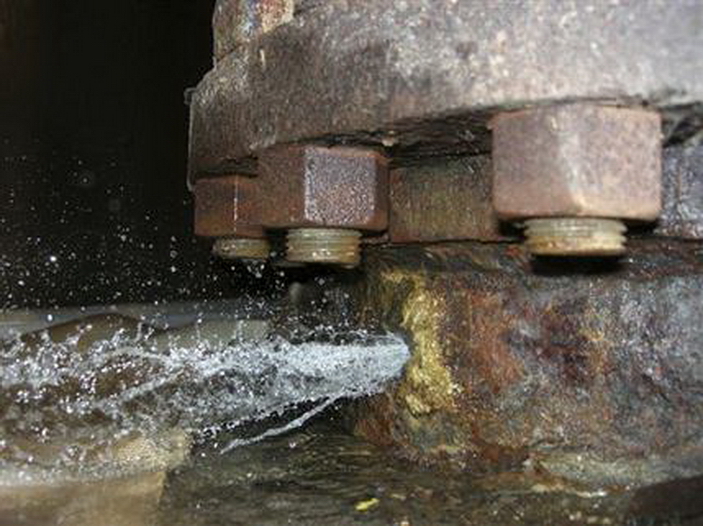
The relative safety of nuclear power in the U.S. is tenuous, despite what some politicians have claimed. A big problem is that the Nuclear Regulatory Commission (NRC) has been working with the nuclear power industry to keep our country’s reactors operating within safety standards, but they’ve been doing it by either weakening those standards, or not enforcing them at all. A year-long investigation by the Associated Press (AP) revealed that the NRC has acted appallingly, extending licenses for dozens of aging U.S. nuclear plants despite their having multiple problems, like rusted pipes, broken seals, failed cables and leaking valves. When such problems are found, the NRC will weaken the standards to help the plants meet them instead of ordering them to be repaired to meet current standards. The nuclear industry argues that the standards they are violating are “unnecessarily conservative,” and in response, the NRC simply loosens the standards. Just last year, for example, the NRC weakened the safety margin for acceptable radiation damage to nuclear reactor vessels — for the second time. Through public record requests to the NRC, the AP obtained photographs of badly rusted valves, holes eaten into the tops of reactor vessels, severe rust in pipes carrying essential water supplies, peeling walls, actively leaking water pipes and other problems found among the nation’s fleet of aging nuclear reactors.
The Take Away
Fukushima has been a wake up call about the dangers of nuclear power, and some countries are heeding the information. But it seems the U.S. is still sleeping when it comes to this issue. Light-to-absent coverage of TEPCO’s struggles to bring Fukushima under control, legislators who insist on acting favorably towards the nuclear power industry despite the deteriorated state of our current reactor fleet and an ineffective Nuclear Regulatory Commission have all contributed to a bad combination of a dangerous situation and a complacent American public on this issue.
Maybe now that the latest scandal in Washington has subsided, public and media attention will return to this crucial issue, and the U.S. will turn its attention to tackling some of the truly serious problems posed by a continuing reliance on nuclear power. Anne Landman is the Managing Editor of the Center for Media and Democracy. She previously served as the editor of our TobaccoWiki project on our SourceWatch.org website. She has degrees in Environmental Restoration/Waste Management Technology and Communications.
Donate To Keep This Site Alive
______________________________________________________ ___________________________ . .
VIDEO: MISSOURI THE BEAUTIFUL Take a patriotic tour of the Show Me State's natural wonders . . _____________________________________________________________________________
This photo made available by the Nuclear Regulatory Commission shows a 10-gallon-per-minute leak which sprung Oct. 19, 2007, in rusted piping that carried essential service water at the Byron nuclear plant in Illinois. The water is needed to cool the reactor in an emergency. The plant was immediately taken offline for repairs. Federal regulators have been working closely with the nuclear power industry to keep the nation's aging reactors operating within safety standards by repeatedly weakening those standards, or simply failing to enforce them, an investigation by The Associated Press has found. Time after time, officials at the U.S. Nuclear Regulatory Commission have decided that original regulations were too strict, arguing that safety margins could be eased without peril, according to records and interviews. (AP Photo/Nuclear Regulatory Commission)
U.S. nuclear power plant operators haven't figured out how to quickly detect leaks of radioactive water from aging pipes that snake underneath the sites - and the leaks, often undetected for years, are not going to stop, according to a new report by congressional investigators.
The report by the Government Accountability Office was released by two congressmen Tuesday in response to an Associated Press investigation that shows three-quarters of America's 65 nuclear plant sites have leaked radioactive tritium, sometimes into groundwater.
Separately, two senators asked the GAO, the auditing and watchdog arm of Congress, to investigate the findings of the ongoing AP series Aging Nukes, which concludes that the U.S. Nuclear Regulatory Commission and the nuclear power industry have worked closely to keep old reactors operating within safety standards by weakening them, or not enforcing the rules.
A third senator, independent Bernie Sanders of Vermont, said the AP series has raised disturbing allegations about safety at aging plants and reiterated his demand that the Vermont Yankee plant be shut.
In the report released Tuesday by Democratic Reps. Edward J. Markey of Massachusetts and Peter Welch of Vermont, the GAO concluded that while a voluntary initiative that industry recently adopted is supposed to identify leaks, the U.S. Nuclear Regulatory Commission doesn't know how fast problems are detected.
"Absent such an assessment, we continue to believe that NRC has no assurance that the Groundwater Protection Initiative will lead to prompt detection of underground piping system leaks as nuclear power plants age," the report's authors concluded.
No leak is known to have reached aquifers that hold the drinking water supplies of public utilities, though tritium, a radioactive form of hydrogen, has contaminated residential drinking wells near at least three nuclear power plants. The tritium in those wells did not surpass the federal health standard. Though mildly radioactive, tritium poses the greatest risk of causing cancer when it ends up in drinking water.
Markey's spokeswoman said his office received the GAO report in early June after requesting it in 2009 following reports of a tritium leak at the Indian Point nuclear plant north of New York City. Typically congressional offices hold reports for 30 days, but Markey released it in response AP's tritium story, part of an ongoing investigative series.
In a written statement, he compared the ongoing nuclear crisis at Japan's Fukushima Dai-ichi plant to the kind of meltdown he said could happen in the U.S. if a pipe that is supposed to carry water to cool a reactor's core fails.
"There would be no warning because no one ever checks the integrity of these underground pipes," Markey said.
The industry's Nuclear Energy Institute cited its "underground piping integrity initiative policy," launched voluntarily in 2009, as proof that it takes tritium leaks seriously.
"The initiative commits the industry to a series of actions to establish more frequent inspection and enhance dependability of underground piping with a goal of protecting structural integrity and preventing leaks," the institute said in a statement.
The institute also criticized AP's overall findings and "selective, misleading reporting in a series of new articles on U.S. nuclear power plant safety."
Previously, the AP reported that regulators and industry have weakened safety standards for decades to keep the nation's commercial nuclear reactors operating. While NRC officials and plant operators argue that safety margins can be eased without compromising safety, critics say these accommodations are inching the reactors closer to an accident.
In response to those findings, New Jersey's two Democratic senators asked the GAO for a new investigation based on "the serious allegations" documented by the AP.
"It would be of grave concern to us if, in fact, aging power stations have achieved compliance with operating rules because of weakened NRC rules, rather than demonstrated compliance with existing standards," Sens. Frank R. Lautenberg and Robert Menendez wrote.
In a Senate speech Tuesday, Sanders said the NRC and Vermont Yankee operator Entergy have ignored the will of Vermonters. The Vermont state Senate recently voted to close the plant once its license expires next year.
He also called for a GAO investigation into the safety issues raised in the AP series. "These allegations by the AP are incredibly disturbing," Sanders said. "Safety at our nuclear plants should be the top priority at the NRC, particularly after what we saw happen in Japan. They should not answer to the nuclear industry, the NRC must answer to the public."
Sanders said the investigation should determine whether the NRC is systematically working with industry to undermine safety standards to keep aging plants operating.
California Democrat Barbara Boxer, chairwoman of the Senate's Environment and Public Works Committee, said she is supporting Sanders.
Late Tuesday, the NRC said it disagreed with AP's conclusions in the stories, but welcomed the attention to nuclear plant safety the stories have generated. The agency defended its standards and approach to safety.
"The NRC never wavers from its primary mission - ensuring that the public remains safe during the civilian use of radioactive materials in the United States," the statement said.
Addressing the main issue of the AP series regarding weakening of standards, the NRC said it "only endorses changes when they maintain acceptable levels of public safety; this can include adding or strengthening requirements.
. VIDEO: Nuclear Power Spent Rod Storage Worries World Wide Dilemma NO NEW NUKE PLANTS ANYTIME SOON pt.1
.
Donate To Keep This Site Alive
______________________________________________________ ___________________________ . .
VIDEO: MISSOURI THE BEAUTIFUL Take a patriotic tour of the Show Me State's natural wonders . . _____________________________________________________________________________
Coronal mass ejection as viewed by the Solar Dynamics Observatory on June 7, 2011. CREDIT: NASA/SDO _________________________________________________________________________
Sun Unleashes 'Spectacular' & Powerful Eruption
by Tariq Malik, SPACE.com Managing Editor
Date: 07 June 2011
___________________________________________________________________________
The sun unleashed a massive solar storm today (June 7) in a dazzling eruption that kicked up a vast cloud of magnetic plasma that appeared to rain back down over half of the sun's entire surface, NASA scientists say.
The solar storm hit its peak at about 2:41 a.m. EDT (0641 GMT), but the actual flare extended over a three-hour period, said C. Alex Young, a solar astrophysicist at NASA's Goddard Space Flight Center who runs a website called The Sun Today, in a video describing the event.
"The sun produced a quite spectacular prominence eruption that had a solar flare and high-energy particles associated with it, but I've just never seen material released like this before," Young said. "It looks like somebody just kicked a giant clod of dirt into the air and then it fell back down." Huge sun Eruption June 7, 2011
.
.
NASA's Solar Dynamics Observatory spacecraft caught high-definition video of the flare in different wavelengths. The event registered as a Class M-2 solar flare, which is a medium-class sun storm that should not pose a danger to satellites or infrastructure on Earth.
An alert by the NOAA-operated Space Weather Prediction Center stated that the solar flare could create a strong geomagnetic storm on Wednesday (June 9) from the event's coronal mass ejection (CME), an explosion of charged particles triggered by the flare. Geomagnetic storms can lead to stronger than normal displays of Earth's auroras, also known as the northern and southern lights.
"It's nothing we really have to worry about," Young said in his video. "It's just really, really beautiful."
The coronal mass ejection is directed at Earth and moving at about 3.1 million mph (5 million kph), SDO mission scientists said in a statement.
"Due to its angle, however, effects on Earth should be fairly small. Nevertheless, it may generate space weather effects here on Earth in a few days," they added.
In the SDO videos, the solar flare erupts from the lower right of the sun and triggers the intense coronal mass ejection, which blows plasma and particles high up into the sun's corona — its outer atmosphere — with some raining back down.
SDO mission scientists said the flare kicked up relatively cool gas and material.
"It is somewhat unique because at many places in the eruption there seems to be even cooler material —at temperatures less than 80,000 Kelvin," SDO scientists explained.
A temperature of 80,000 Kelvin is about 143,540 degrees Fahrenheit (nearly 79,727 degrees Celsius). The sun's corona typically has temperatures ranging from 900,000 degrees F (500,000 degrees C) to 10.8 million degrees F (6 million degrees C). It can reach tens of millions of degrees when a solar flare occurs.
The sun is currently going through an active period in it is 11-year solar weather cycle. The current cycle is called solar cycle 24.
Several NASA spacecraft are keeping constant watch on the sun for flares and CMEs, and serve as an early-warning system for major space weather events.
___________________________________________ _____________________________________ . . Donate To Keep This Site Alive
______________________________________________________ ___________________________ . . VIDEO: MISSOURI THE BEAUTIFUL Take a patriotic tour of the Show Me State's natural wonders . . _____________________________________________________________________________